GRP and Composite Garage Doors: What They Are and Who They Suit


"Composite garage door" is one of those phrases that means different things depending on who is using it. Some people mean a GRP (fibreglass) up and over door made to look like timber. Others mean an insulated door built from metal skins around a foam core. This guide explains what each one is, how they compare with steel and timber, and where each makes sense.
What is a GRP garage door?
GRP stands for glass reinforced plastic, better known as fibreglass. A GRP door panel is moulded rather than pressed from steel or built up from boards, which means it can be given a convincing woodgrain texture and traditional panel patterns. GRP is most often used for up and over and side hinged doors, and it is a popular choice for homes where a timber look suits the house but nobody wants to repaint a timber door every few years.
The advantages
- No rust and no rot. GRP does not corrode like steel or rot like timber, which suits exposed sites and garages that catch a lot of weather.
- Low maintenance. An occasional wash down is usually all it needs.
- A timber look without the upkeep. Moulded woodgrain finishes sit comfortably on period cottages, barn conversions and older brick homes.
- Lighter than solid timber, which is kinder to the springs and hinges over the years.
The drawbacks
- Impact damage. A hard knock from a car bumper is more likely to crack GRP than to dent steel, and cracks are harder to repair invisibly.
- Colour change over time. Older GRP doors were prone to fading and yellowing in strong sun. Modern formulations are much more stable, but a door that faces the sun all day will still weather over many years.
- Less choice of styles and colours than steel, which comes in a huge range.
- Limited insulation. A standard GRP door is not an insulated door, so it will not do much to keep an attached garage warm.
What do people mean by a composite garage door?
Insulated composite panels
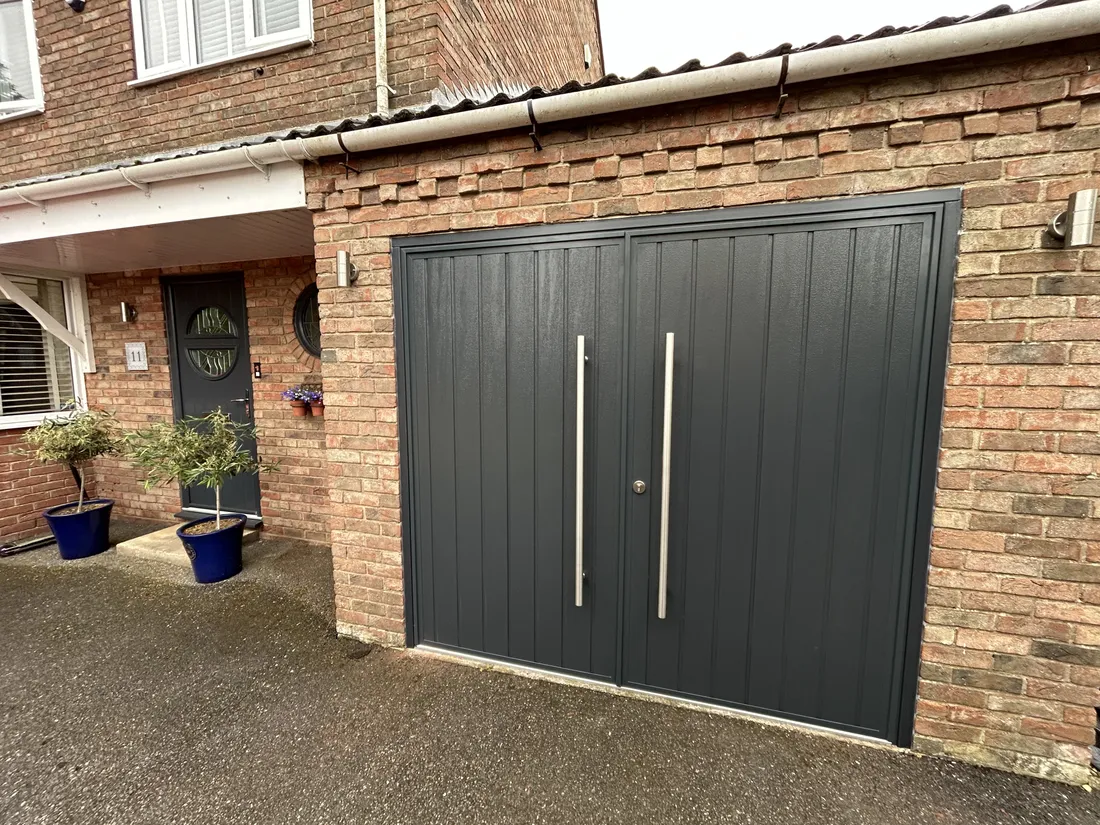
Many modern insulated garage doors are, strictly speaking, composite: two metal skins bonded to a foam core. Insulated sectional doors are built from steel faced panels like this, and insulated roller doors use foam filled slats. Insulated side hinged garage doors with composite panels are a popular way to get a traditional opening style with modern insulation and multi-point locking.
GRP sold as composite
Because fibreglass is technically a composite material, some suppliers describe GRP doors as composite. Both descriptions are fair, but they are very different doors. If you are comparing quotes, ask exactly what the panel is made of and whether it is insulated.
How they compare with steel and timber
| Single skin steel | Insulated composite panel | GRP | Timber | |
|---|---|---|---|---|
| Look | Wide range of styles and colours | Smooth or woodgrain finishes in many colours | Moulded woodgrain, traditional styles | Natural wood, painted or stained |
| Upkeep | Low | Low | Low | Regular treatment needed |
| Rust or rot | Can rust if the coating is damaged | Can rust if the coating is damaged | Neither | Can rot if neglected |
| Insulation | Minimal | Good | Limited | Moderate |
| Knocks | Dents | Dents, but stiffer | Can crack | Can dent or split |
Which door types come in GRP or composite?
- Up and over: available in steel, GRP and timber, so you can choose the material separately from the mechanism. See our up and over garage doors.
- Side hinged: available in steel, timber and GRP, as well as insulated composite panels. See side hinged garage doors.
- Sectional and roller: these are made from insulated panels or slats, so they are composite in the insulated sense, but they are not normally made in GRP. See sectional and roller garage doors.
Who should choose GRP?
GRP tends to make most sense if:
- you want the look of a timber door without the painting and staining;
- your garage is detached or used mainly for storage, so insulation matters less;
- the door takes a lot of weather and you are worried about rust;
- you are replacing an old GRP or timber up and over door and want a similar look.
If the garage is attached to the house, sits under a bedroom, or doubles as a workshop or gym, an insulated composite door will usually serve you better. Our insulated garage doors guide goes into that choice in more detail.
Whatever the material, look closely at the locking as well as the panel. A handsome door with a single basic lock is still a weak point, especially if the garage connects to the house.
See the materials before you decide
Materials are much easier to judge in person than from a brochure. At our Grantham showroom you can see and operate full size doors and compare finishes and colour samples side by side. The team is there Monday to Thursday, 9am to 5pm, and Friday, 9am to 3pm, and you do not need an appointment.
We also offer free surveys and quotes across the area, from Newark and Sleaford to Stamford and Bourne, and interest-free credit on garage doors.
Frequently Asked Questions
Are GRP garage doors any good?
Yes, for the right home. They do not rust or rot, they need very little maintenance, and they are a good way to get a timber look. They are less resistant to hard knocks than steel and offer little insulation, so they suit detached and storage garages best.
Is a composite garage door the same as a GRP door?
Not always. Some suppliers use "composite" to mean GRP, while others mean an insulated door made from metal skins around a foam core. Ask what the panel is made of and whether it is insulated before you compare prices.
Do GRP garage doors fade?
They can weather slowly over many years, particularly on a door that faces the sun. Modern GRP is far more resistant to fading and yellowing than the doors of a few decades ago.
Can a GRP garage door be electric?
That depends on the mechanism rather than the material. Retractable up and over doors are often good candidates for automation, while canopy doors have more limitations. Our guide to electric garage door openers explains what works with which type of door.
Talk it through with us
If you are weighing up GRP, steel, timber or an insulated door, get in touch or call us on 01476 833131 and we will help you find the right fit for your home and your garage.