Base Awnings: Premium British-Made Awnings That Won't Break the Bank

_format(webp)_sB724.webp)
Base Awnings: Premium British-Made Awnings That Won't Break the Bank
There is a common assumption in the awning world that you either spend a small fortune on a European-engineered cassette awning or you take a gamble on a budget import and hope for the best. For years, that was a fairly accurate picture of the market. But Base Direct, a UK manufacturer operating out of the West Midlands, has been quietly changing that equation.
Base Direct grew out of BAT Engineering, a company with over 35 years of experience in precision aluminium fabrication. That heritage matters. When you are bending, welding, and powder-coating aluminium cassettes day in, day out for three decades, you develop a deep understanding of what works and what falls apart after a couple of British winters. Base took that engineering knowledge and applied it specifically to the residential awning market, producing a range of full-cassette and semi-cassette awnings that compete with continental imports at a significantly lower price point.
At GDCG, we have been fitting Base awnings across Lincolnshire, Nottinghamshire, and the surrounding counties for several years now. We chose to stock them because we were genuinely impressed by the build quality relative to the price, and because the after-sales support from a UK-based manufacturer makes our lives (and our customers' lives) considerably easier. This article covers everything you need to know about the Base range, from individual models and specifications through to installation and long-term care.
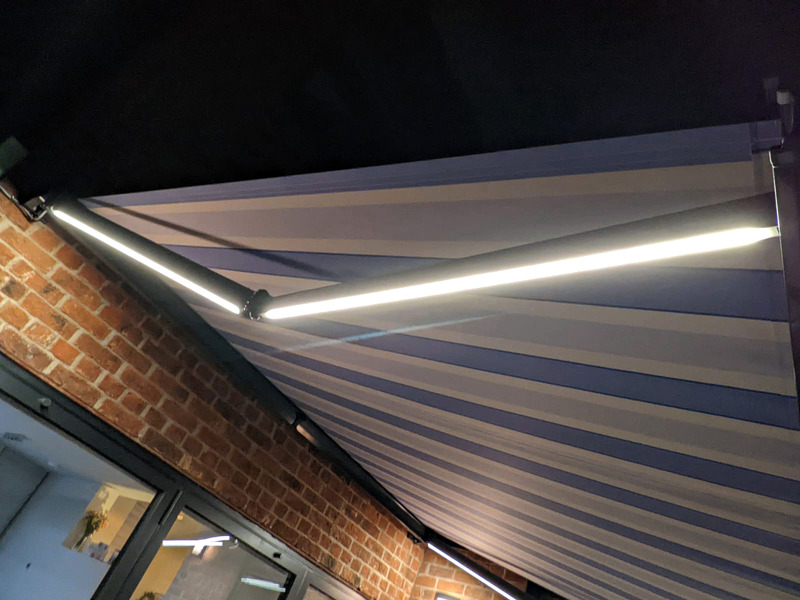
Why Choose a British-Made Awning?
The practical advantages of buying from a UK manufacturer are easy to overlook when you are browsing glossy brochures, but they make a real difference once you have placed an order.
Shorter Lead Times
A Base awning ordered through GDCG typically arrives in three to four weeks. Compare that to six to ten weeks for many European-manufactured models, and it becomes clear why lead time matters, especially if you are ordering in late spring and want to actually use the awning that summer. Base manufacture to order in the West Midlands, which means no lengthy shipping from overseas factories or customs delays.
Designed for UK Weather
This is not marketing spin. The UK climate presents specific challenges that awnings designed primarily for Mediterranean conditions do not always handle well. High humidity, salt-laden coastal air, sideways rain, and the particular quality of British UV exposure all take their toll. Base engineer their products for these conditions from the outset, using marine-grade powder coatings and corrosion-resistant fixings as standard rather than as optional upgrades.
Local Support Network
If something goes wrong with an awning from an overseas manufacturer, getting warranty parts or technical support can be a drawn-out process. With Base, their technical team is a phone call away, parts are held in UK stock, and the line of communication between installer and manufacturer is direct. We have had situations where a customer needed a replacement component, and it arrived within days rather than weeks.
The Base Range at GDCG
Base offer three core models, each designed for a different use case and budget. Here is a straightforward breakdown.
Base Lite
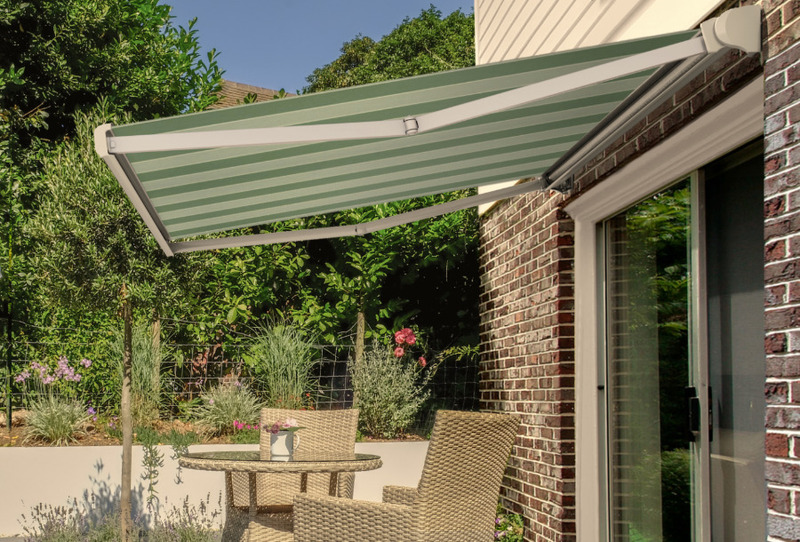
The Base Lite is the entry point to the range and represents remarkable value for a full-cassette awning. Starting from around £2,000 installed, it offers features that you would typically only find on awnings costing considerably more.
The Lite uses a compact aluminium cassette that fully encloses the fabric and mechanism when retracted. This is important because it protects the fabric from UV degradation, bird droppings, and general weathering when the awning is not in use. Budget awnings often use open-roller designs that leave the fabric exposed, which dramatically shortens lifespan.
Available in widths up to 5 metres with a maximum projection of 3 metres, the Lite suits most standard patios and decking areas. The arm mechanism uses stainless steel cables rather than chains, providing smooth, consistent tension across the full extension.
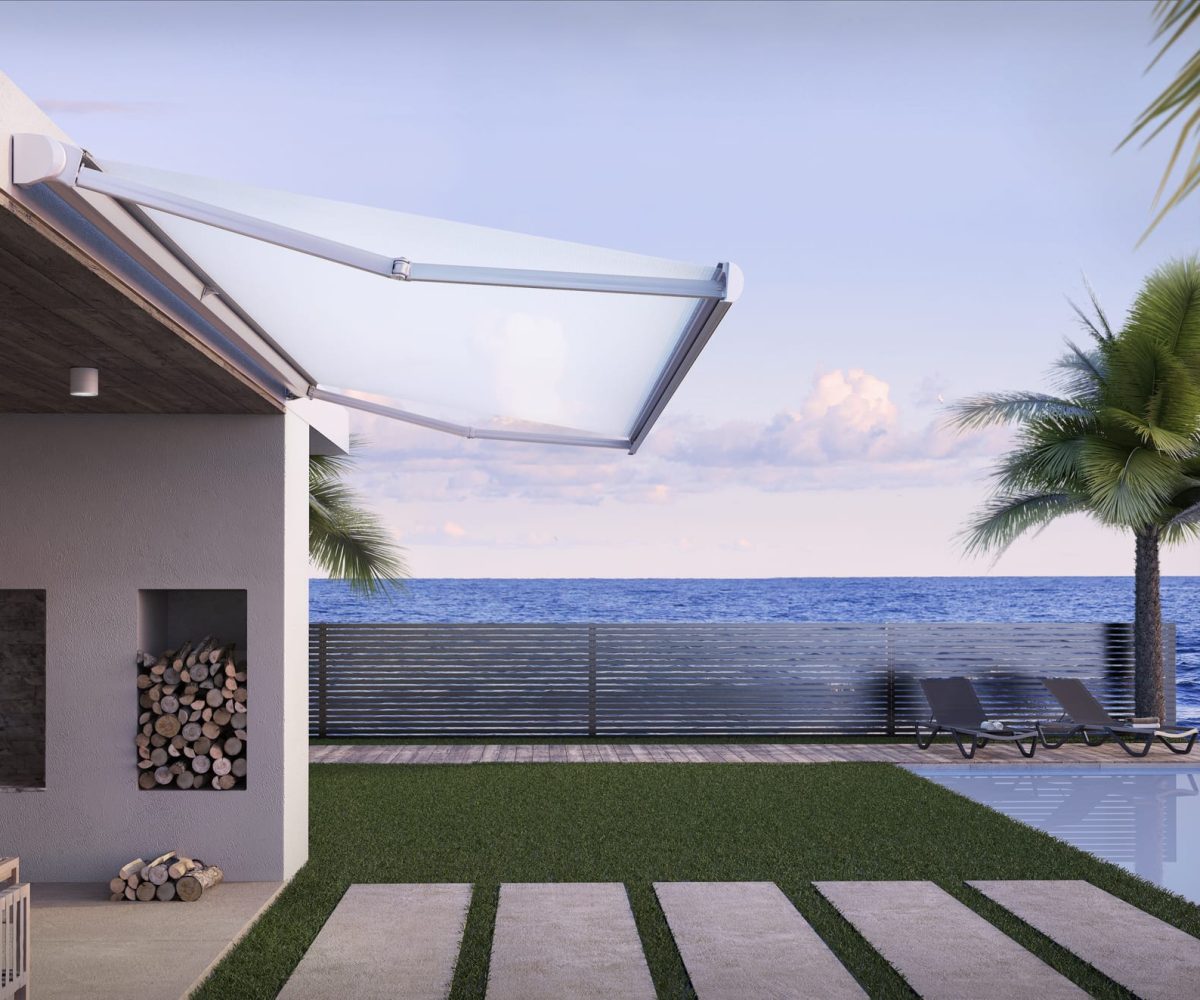
Base Plus
The Plus is the middle of the range and the model we fit most often. Starting from approximately £2,500 installed, it steps up from the Lite with a larger cassette housing, heavier-duty arm construction, and wider size options.
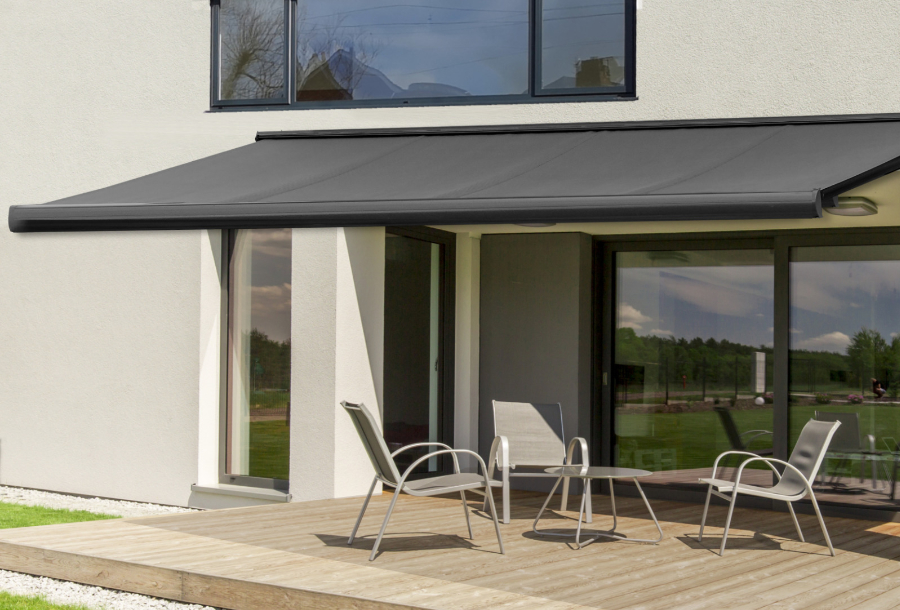
The Plus is available in widths up to 6 metres and projections up to 3.5 metres, making it suitable for larger entertaining spaces and wider bifold door openings. The arm geometry is slightly different from the Lite, using a dual-cable system that provides greater wind resistance and a more even fabric tension at full extension.
One of the things we particularly like about the Plus is the range of cassette colours available. The powder-coated aluminium comes in a selection of RAL colours, so you can match or contrast with your property's existing colour scheme. Grey and anthracite remain the most popular choices, but white and cream are equally well suited to period properties.
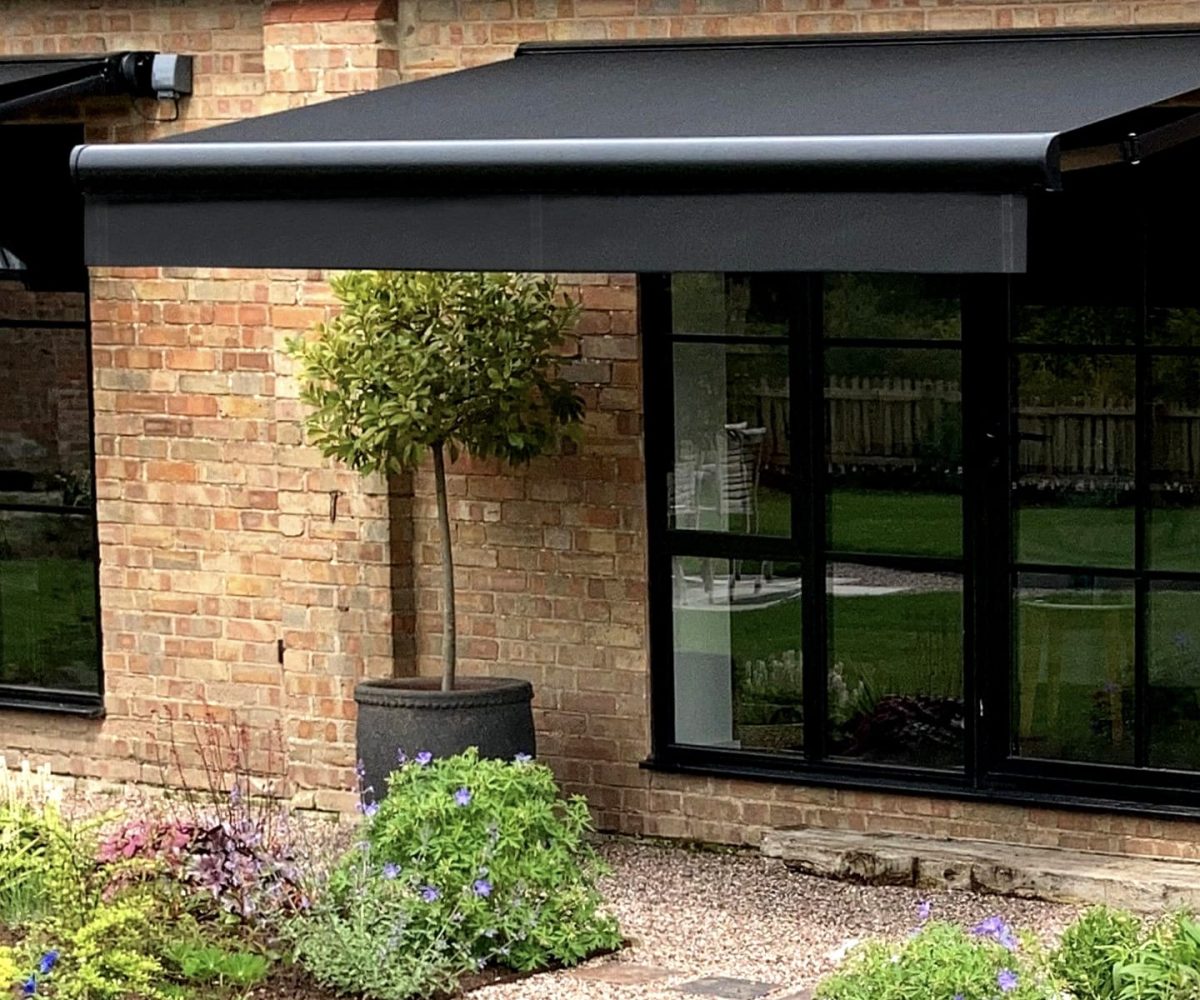
Italia Slim
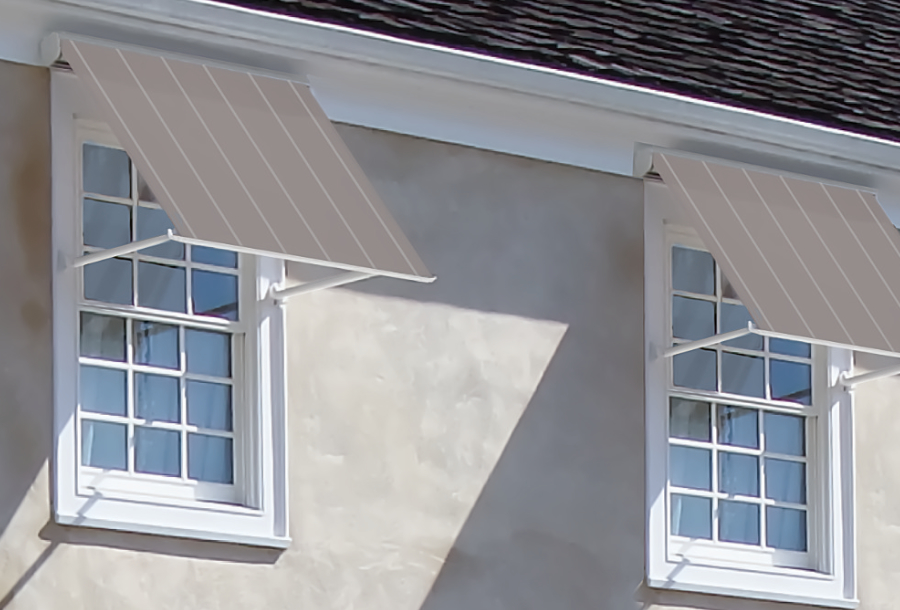
The Italia Slim is designed for situations where mounting space is limited. Some properties have very little room between the top of the door or window and the soffit or roofline, and a standard cassette simply will not fit. The Italia Slim addresses this with a reduced-profile cassette that tucks neatly into tight spaces without compromising on fabric quality or arm performance.
It is also a strong choice for balcony installations where the fixing area is restricted and the overall look needs to be as unobtrusive as possible. The Slim supports widths up to 5 metres and offers the same fabric and colour options as the rest of the range.
Build Quality and Materials
Fabric
All Base awnings use Dickson acrylic fabrics as standard. Dickson are a French textile manufacturer with a long-established reputation in the awning industry. Their acrylic fabrics are solution-dyed, meaning the colour runs through the entire fibre rather than being applied to the surface. This is a critical distinction because surface-dyed fabrics fade significantly faster under UV exposure. Dickson fabrics carry a five-year warranty against fading and are treated to resist water and mould.
The fabric range includes well over 100 colourways, from plain block colours through to traditional stripes. If you visit our showroom in Grantham, we keep fabric samples from the full Dickson range so you can see and feel the material before committing.
Cassette and Framework
The aluminium used in Base cassettes is 6063-T5 grade, the same alloy commonly specified in architectural applications for its combination of strength, corrosion resistance, and suitability for anodising and powder coating. Each cassette is powder-coated to a minimum 60-micron thickness, which exceeds the Qualicoat standard for architectural coatings.
The internal components, including spring mechanisms, cable tensioners, and pivot points, use stainless steel and self-lubricating bearings. These are the parts that tend to fail first on cheaper awnings, where mild steel components rust and seize within a few seasons.
Wind Resistance
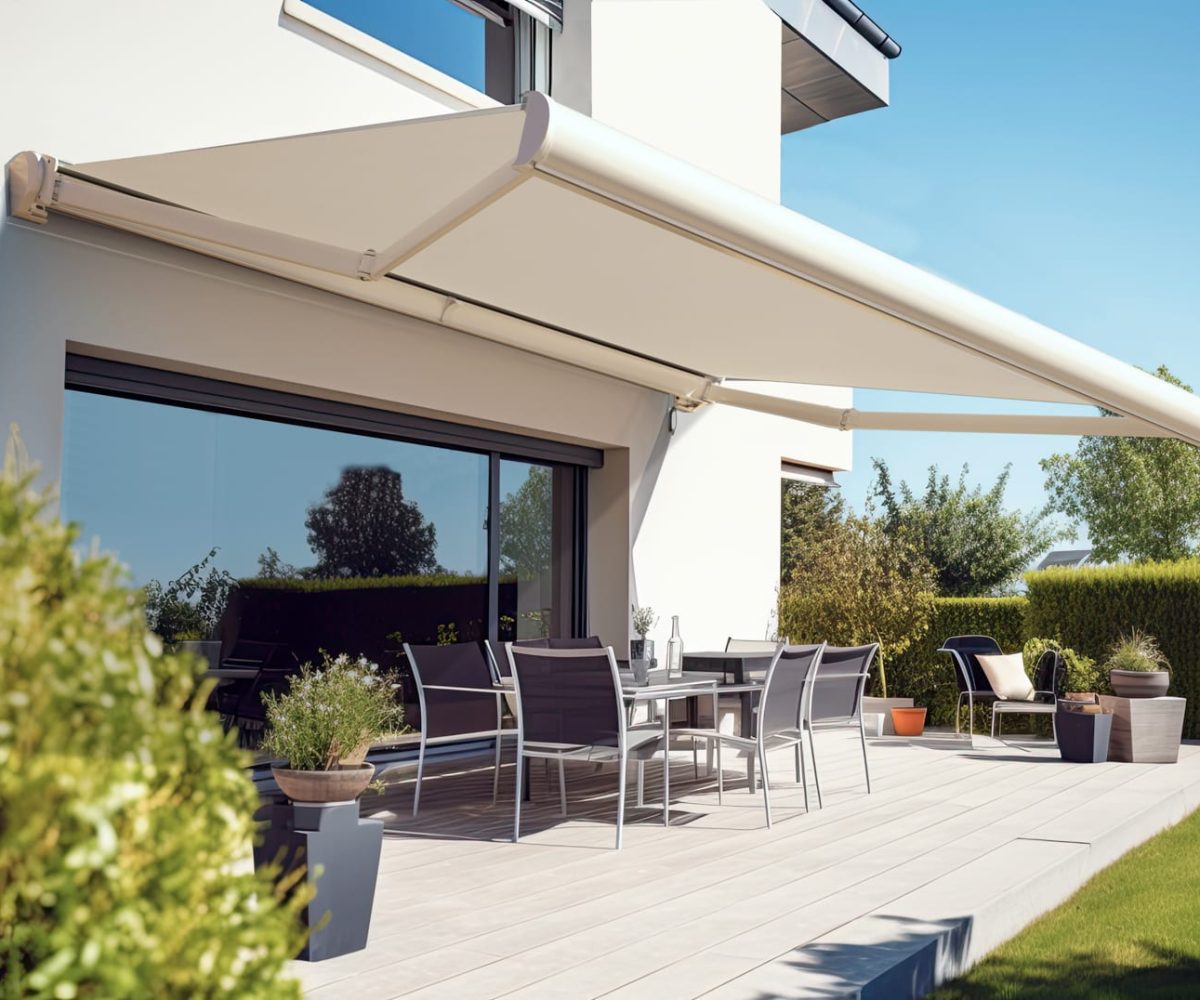
Base awnings are rated to Beaufort Force 5 (approximately 19 to 24 mph) as standard. With the addition of an optional wind sensor, the awning will automatically retract when wind speeds exceed the safe threshold. We strongly recommend the wind sensor for motorised installations, as it provides peace of mind when you are away from home or forget to retract the awning before a storm rolls in.
Manual vs Motorised
Every model in the Base range is available in either manual (crank handle) or motorised versions.
Manual Operation
A manual awning uses a detachable crank handle to extend and retract the fabric. The gearing is smooth and well-engineered, so even larger awnings do not require excessive effort to operate. Manual operation suits situations where the awning is used occasionally and the homeowner is happy to operate it by hand. It is also the most cost-effective option.
Motorised Operation
Adding a Somfy tubular motor to any Base awning typically adds between £300 and £400 to the overall cost. Somfy are the industry-standard motor manufacturer for awnings and shutters, and their motors are exceptionally reliable, quiet, and energy-efficient.
A motorised awning is operated by a handheld remote control. You can also add optional extras such as a sun sensor (the awning extends automatically when UV levels reach a set threshold) and a wind sensor (automatic retraction in high winds). For smart home enthusiasts, Somfy motors can integrate with home automation systems including the Somfy TaHoma hub.
When to Go Motorised
We generally recommend motorised operation in the following situations:
- The awning is wider than 4 metres (cranking a large awning in and out becomes tedious)
- The awning is installed above the first floor or in a hard-to-reach position
- You want to add automated wind or sun sensors
- The awning will be used daily during the summer months
- Accessibility is a consideration for any household member
For awnings under 3 metres wide that will see occasional use, manual is perfectly adequate and saves you the additional cost.
Choosing the Right Size and Style
Measuring Up
The two key dimensions for any awning are width and projection. Width is the measurement along the wall where the awning will be mounted. Projection is how far the awning extends outward from the wall when fully open.
As a general rule, the awning should be at least as wide as the door or window opening it sits above, ideally 30 to 50 cm wider on each side to provide proper shade coverage. For projection, consider where the sun falls at different times of day. A south-facing patio in midsummer will need a greater projection than a west-facing space that only catches late afternoon sun.
Projection Recommendations
- Small patio or balcony (up to 2m deep): 2m to 2.5m projection
- Standard patio or decking (2m to 3m deep): 2.5m to 3m projection
- Large terrace or outdoor dining area: 3m to 3.5m projection
Remember that projection also affects shading angle. A shorter projection angled more steeply downward can sometimes shade a wider area than a longer, flatter projection.
Wall Types and Fixings
The fixing method depends on your wall construction. Brick and block walls use standard expanding masonry bolts. Timber-framed buildings require bolts that pass through the cladding and into the structural frame. Stone walls, particularly older properties with rubble-filled cavities, may need specialist resin fixings.
During our survey visit, we assess the wall construction and confirm the fixing method before placing any order. This avoids surprises on installation day and ensures the awning is securely mounted for the long term.
Installation: What to Expect
The GDCG Process
Our process is straightforward. It starts with either a visit to our Grantham showroom or a phone call on 01476 833131 to discuss your requirements. From there, the typical steps are:
Site survey. One of our team visits your property to measure up, assess the mounting position, check for any obstructions (downpipes, satellite dishes, lighting), and discuss fabric and colour choices.
Quotation. We provide a written quote within a few days of the survey, covering the awning, any accessories (motors, sensors, remote controls), and installation.
Order and manufacture. Once you confirm, we place the order with Base Direct. Manufacturing typically takes three to four weeks.
Installation. Fitting a single awning usually takes between two and four hours, depending on the size and wall type. We carry out the electrical connection for motorised models (all our installers are Part P certified for electrical work).
Handover. We demonstrate the operation, set any sensor thresholds, and leave you with full documentation and warranty information.
Disruption
Installation is not particularly invasive. We drill into the external wall above the door or window, mount the brackets, hang the cassette, and test the operation. There is no internal work unless you want the motor hardwired to an internal switch (most customers are happy with the remote control). We clean up all drilling dust and debris before we leave.
Base Awnings for Different Spaces
Small Patios and Courtyard Gardens
The Base Lite is ideal for compact spaces. Its smaller cassette profile means it does not visually dominate a small wall area, and widths from 2.5 metres upward cover most small patio openings. In courtyard gardens where space is tight, the ability to fully retract the awning into a sealed cassette is particularly valuable, as it keeps the awning out of the way when you need the full height clearance.
Large Terraces and Entertaining Areas
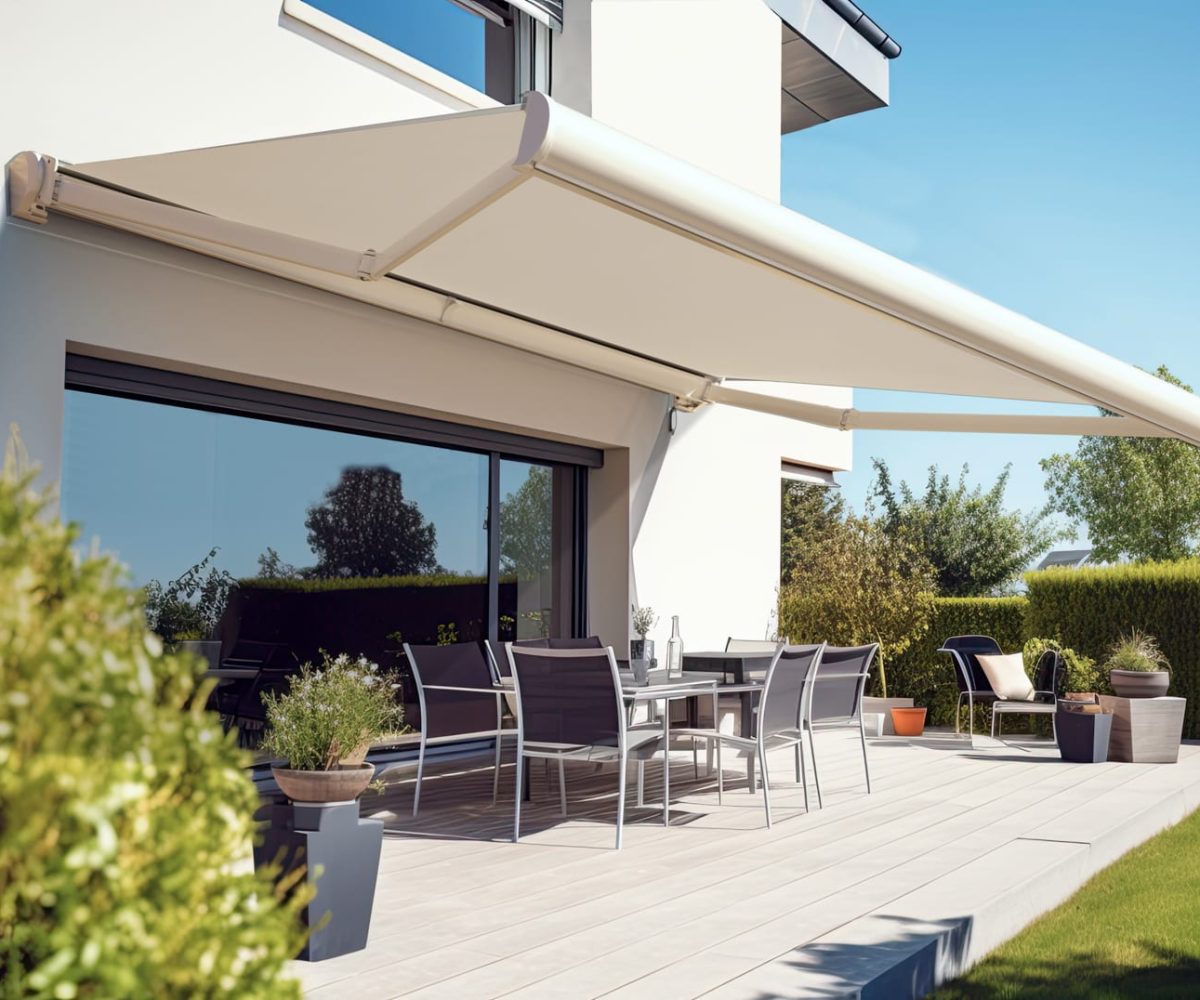
The Base Plus, with its 6-metre maximum width and 3.5-metre projection, is built for larger outdoor living spaces. For particularly wide openings, two awnings can be mounted side by side with a minimal gap between the cassettes. This coupled approach is common on properties with wide rear elevations and allows for flexible shading, as you can extend one or both awnings depending on conditions.
Balconies and Upper Floors
The Italia Slim is purpose-built for these scenarios. Balcony installations present unique challenges: limited fixing space, restricted headroom, and increased wind exposure. The Slim's compact profile and lightweight construction make it the obvious choice. We always recommend motorised operation with a wind sensor for any balcony installation, as retracting an awning quickly in gusty conditions at height is not something you want to be doing with a crank handle.
Why Quality Matters
It can be tempting to save a few hundred pounds on a budget import awning from an online retailer. Some of these products look perfectly reasonable in photographs and come with impressive-sounding specifications. The problems tend to emerge six to eighteen months down the line.
Common issues with cheaper imported awnings include:
- Fabric fading. Low-quality acrylic or polyester fabrics lose colour rapidly under UK UV levels, leaving you with a washed-out, patchy appearance.
- Arm mechanism failure. Cheap gas struts and mild steel cables stretch, corrode, and eventually snap. Replacement parts for discontinued import models are often impossible to source.
- Cassette corrosion. Thin powder coatings and inferior aluminium alloys develop white oxidation patches, particularly in exposed or coastal locations.
- No warranty support. Many online-only retailers offer limited or non-existent warranty backing. If the seller goes out of business, which happens frequently in the budget end of the market, you are left with no recourse.
A well-made awning from a reputable manufacturer, properly installed, should last fifteen to twenty years with minimal maintenance. A budget import may need replacing in three to five years. The total cost of ownership nearly always favours the quality product.
Frequently Asked Questions
Are Base awnings any good?
Yes. Base awnings offer genuine quality at a competitive price point. They are manufactured in the UK using high-grade aluminium, Dickson acrylic fabrics, and Somfy motors. The engineering heritage from BAT's 35-plus years in aluminium fabrication is evident in the build quality. We have been fitting Base awnings for several years and the feedback from customers has been consistently positive. Warranty claims have been extremely rare.
How much do Base awnings cost?
Prices vary depending on the model, size, and specification. As a rough guide, a Base Lite starts from around £2,000 fully installed, and a Base Plus from approximately £2,500 fully installed. Adding motorisation typically adds £300 to £400. Larger sizes, premium fabric choices, and accessories like wind sensors and sun sensors will increase the price. We provide a detailed written quotation after a site survey so there are no hidden costs.
How long does a Base awning last?
With proper care, a Base awning should last 15 to 20 years. The aluminium cassette and arms are extremely durable and effectively maintenance-free. The Dickson fabric carries a five-year manufacturer's warranty against fading but will typically remain in excellent condition for ten years or more if retracted when not in use and given an occasional gentle clean. The Somfy motors used in motorised models are rated for tens of thousands of operating cycles.
Can I get a Base awning motorised?
All models in the Base range, including the Lite, Plus, and Italia Slim, are available with Somfy motorisation. You can also add a wind sensor for automatic retraction in high winds, a sun sensor for automatic extension in bright conditions, and remote-control operation. If you initially choose a manual awning, it is possible to retrofit a motor at a later date, although it is more cost-effective to specify motorisation from the outset.
What colours are available?
The Dickson fabric range includes over 100 colourways, spanning solid colours, classic stripes, and contemporary designs. The aluminium cassette is available in a range of RAL powder-coat colours, with grey (RAL 7016 anthracite), white (RAL 9016), and silver being the most popular. We keep the full Dickson fabric sample book and cassette colour samples at our Grantham showroom, so you can see the actual materials before ordering.
Do Base awnings need planning permission?
In the vast majority of cases, no. Domestic awnings are generally considered permitted development and do not require planning permission. However, there are exceptions: listed buildings, properties in conservation areas, and certain flats or maisonettes may require consent. If you are unsure, we can advise during the survey visit or you can check with your local planning authority.
If you would like to see a Base awning in person, visit our showroom in Grantham or give us a call on 01476 833131. We are happy to talk through the options, arrange a site survey, and provide a no-obligation quotation.
_format(webp)_2oLLXp.webp)
_format(webp)_ZpIjLA.webp)
_ZOc1T.webp)
_2sp1Qy.webp)
_17OJCs.webp)
_1QB6sq.webp)
_format(webp)_ZkhIwe.webp)
_format(webp)_Z1MvXNb.webp)
_format(webp)_Zt58y5.webp)